
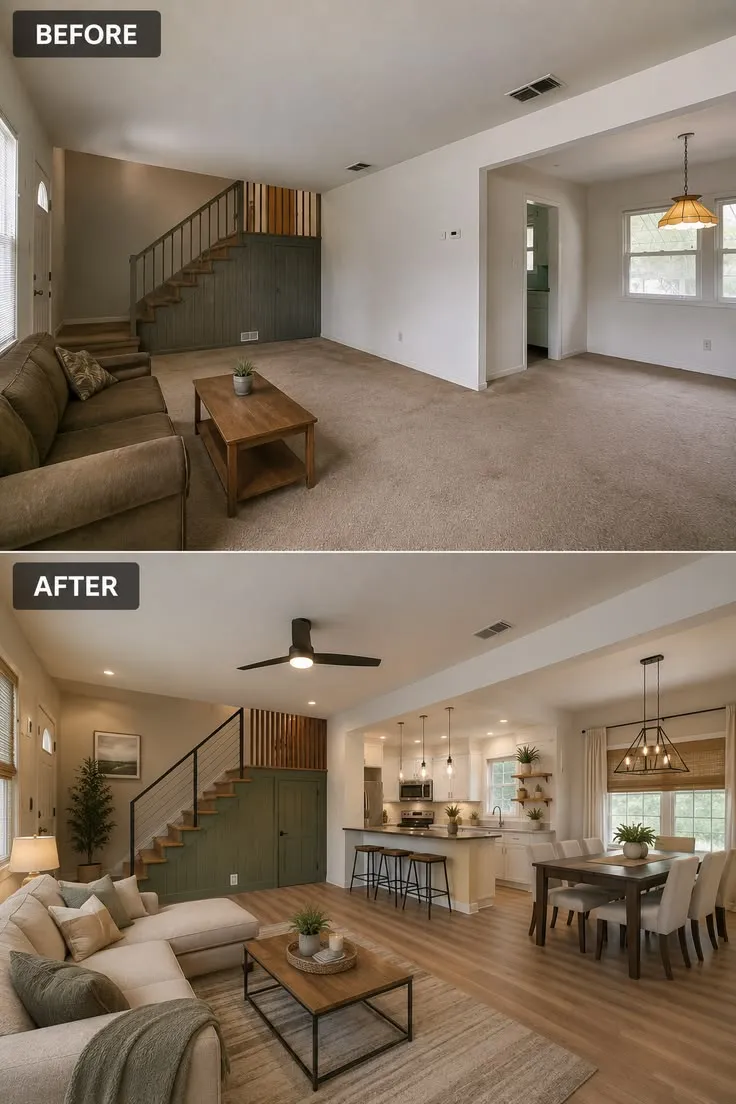
Home renovation decisions have a habit of becoming expensive very quickly. A paint colour that seemed perfect on a small sample may feel completely different across four walls. New flooring can change the mood of an entire room. Even something as simple as replacing dark kitchen cabinets with lighter ones can affect how large, warm, or bright the space appears.
That is why visual planning is becoming such a useful step before renovation work begins. With AI home design, homeowners can start from photographs of their rooms or house exterior and explore possible changes before committing to materials, furniture, or finishes. AI Render Studio’s home-design workflow is designed for both interiors and exteriors, allowing users to experiment with colours, furnishing, façade treatments, and overall style from an existing image.
The important part is not generating the most impressive picture. It is using those pictures to make better decisions about a real home.
Start With the Problem You Actually Want to Solve
Renovation planning often begins with a vague feeling.
“The living room looks dated.”
“The kitchen feels too dark.”
“The front of the house needs something.”
Those observations are useful, but they are not yet design decisions. Before changing anything, it helps to identify what is actually causing the problem. For homeowners who are still exploring possibilities, Render AI free tools can also provide a simple way to test broad visual directions before committing money to materials, furniture, or renovation work.
A living room may feel dated because of the furniture rather than the walls. A kitchen can appear dark because of poor lighting even when the cabinet colour is perfectly suitable. An exterior may lack character because the entrance is difficult to identify, not because the entire façade needs replacing.
Try turning the problem into a more specific question.
For example:
- Would lighter flooring make the room feel more open?
- Does the kitchen need new cabinets or simply a different colour palette?
- Would timber around the entrance add enough warmth to the exterior?
- Is the bedroom too plain because of its furniture or because everything uses the same tone?
- Could better lighting change the atmosphere without a major renovation?
Once the question is clear, visual experimentation becomes much more useful.
Test One Major Change at a Time
One common mistake in home renovation is changing everything at once.
New flooring. Different wall colours. New furniture. New lighting. New curtains. New cabinetry.
The resulting concept may look attractive, but it becomes difficult to understand which change actually improved the room.
A better approach is to work in stages.
Suppose the living room currently has dark flooring and pale walls. Start by testing only the floor. Compare a warmer oak treatment with something lighter and more neutral.
Once the preferred direction becomes clear, move to the walls.
Then furniture.
Then lighting.
This slower visual approach has an advantage: it creates a chain of deliberate decisions rather than one large makeover based on a single generated image.
It also makes it easier to separate what you genuinely like from what simply looks fashionable.
Use Your Actual Home as the Starting Point
Design inspiration websites are full of beautiful rooms, but there is always one problem: they are somebody else’s rooms.
The windows are different.
The ceiling may be higher.
The room could be twice as large.
Natural light may come from another direction.
Even the architecture itself may belong to a completely different type of home.
A photograph of your own space provides a much more relevant foundation.
AI Render Studio’s home-design page specifically supports photographs of existing interiors and house exteriors as starting points, alongside sketches and model exports.
That allows visual experimentation to stay connected to the space you are actually planning to change.
It can be particularly helpful when deciding whether a design style that looks good online will suit the proportions of your own home.
A dramatic dark interior, for example, may work beautifully in a large room with tall windows. The same palette could feel much heavier in a small space with limited daylight.
Seeing the idea applied to your own room makes that difference easier to judge.
Do Not Begin With a Style Name Alone
“Japandi.”
“Minimalist.”
“Industrial.”
“Modern luxury.”
Style labels can be useful, but they are broad. Two people can use the same word and imagine very different interiors.
Instead of relying only on the label, think about the individual qualities you want.
Perhaps what you like about a minimalist room is not minimalism itself. Maybe you respond to:
- fewer visible objects;
- natural materials;
- simple furniture;
- warm neutral colours;
- concealed storage;
- softer lighting.
That is much more useful information.
Likewise, someone who says they want an industrial interior may really be interested in darker metal details and textured materials rather than exposed pipes and concrete everywhere.
Breaking a style into ingredients helps prevent a room from becoming a themed imitation of an online trend.
Your home should still feel like your home.
Kitchens Need Practical Thinking as Well as Visual Inspiration
Kitchens are especially easy to redesign visually because there are so many obvious surfaces to change.
- Cabinet colour.
- Worktops.
- Splashbacks.
- Flooring.
- Lighting.
- Handles.
- Wall finishes.
A visual concept can quickly show whether those choices work together.
But kitchens are also highly functional spaces, so appearance is only the beginning.
A generated concept may suggest beautiful cabinetry but ignore where appliances actually sit. It may show pendant lights in a location where the ceiling layout makes installation difficult. The island could appear larger than the room comfortably allows.
Before taking any visual concept further, check practical issues such as:
Movement: Can people move comfortably between counters and appliances?
Storage: Is there enough usable storage for the household?
Lighting: Are food-preparation areas properly illuminated?
Maintenance: Are the materials realistic for spills, heat, moisture, and daily cleaning?
Budget: Can the finishes shown in the concept be achieved within the renovation allowance?
Visualisation helps with the look. The kitchen still has to work on a busy weekday morning.
Bedrooms Benefit From Restraint
Bedrooms often need less intervention than people think.
When a bedroom feels tired, the instinct may be to redesign every surface. Yet a few controlled changes can have more impact.
Try experimenting with combinations such as:
- a different wall tone;
- warmer bedside lighting;
- new bedding and textiles;
- one stronger material behind the bed;
- simplified furniture;
- improved curtains or blinds.
The advantage of testing changes visually is that you can see when the room has reached enough.
More decoration does not always create more character.
Sometimes the strongest version is the one where an unnecessary feature has been removed.
That is particularly relevant when AI-generated concepts begin introducing decorative wall panels, oversized lights, sculptures, plants, and accessories. Some additions may be appealing, but you do not have to reproduce everything shown in the image.
Treat them as possibilities, not instructions.
Remember the Exterior
Home design does not stop at the front door.
The exterior often determines the first impression of the property, yet homeowners may find it harder to experiment with because exterior changes can feel more permanent.
Changing cladding, paint colours, windows, paving, or landscape can significantly alter a building’s character.
Visual studies make it easier to compare directions before making expensive decisions.
You might test:
- a lighter or darker façade;
- different front-door colours;
- a stronger entrance surround;
- alternative paving;
- reduced or increased planting;
- contemporary versus more traditional finishes.
AI Render Studio’s home-design workflow includes exterior restyling as well as interior changes, including façade colours, cladding, and landscaping concepts.
Again, the image should be treated as inspiration.
Changing windows, external materials, extensions, or other major elements may involve planning rules, building regulations, structural considerations, or specialist installation. A convincing picture does not confirm that the proposed work is technically appropriate.
Use Visuals to Have Better Family Conversations
One person rarely decides renovations.
Partners may have different tastes. Children may have strong opinions about their rooms. A wider family renovation can involve several people who all describe what they want in different ways.
Words such as “warm,” “clean,” “cosy,” and “modern” are surprisingly unreliable.
One person hears “cosy” and imagines timber, soft fabrics, and warm colours.
Another imagines dark paint and heavy furniture.
Visual options make those differences easier to identify.
Rather than asking, “Do you want a warmer living room?” show two genuinely different interpretations.
You may discover that both people agree on the flooring but not the wall colour.
That is progress.
A renovation becomes easier when people are debating specific choices instead of abstract descriptions.
Keep a Shortlist Instead of Generating Endless Versions
AI can make experimentation very easy.
That is useful until it becomes a distraction.
If you create thirty variations of the same room, the differences begin to blur. Suddenly, a decision that initially seemed simple becomes difficult because there are too many alternatives.
A good rule is to reduce options as you work.
Start with several broad ideas.
Choose the strongest two or three.
Then refine those.
For example:
Option A: Warm and Natural
Light oak, cream walls, natural fabrics, and soft lighting.
Option B: Crisp and Contemporary
Paler surfaces, cleaner furniture, black accents, and brighter lighting.
Option C: Deeper and More Intimate
Richer wall tones, darker timber, textured fabrics, and warmer illumination.
These are genuinely different directions.
Once you know which one feels right, there is little value in generating fifteen slight variations of beige.
Build a Real Material Board After Choosing the Look
Screens can mislead.
Colours change from one display to another. Generated materials are visual interpretations rather than guaranteed representations of a product you can buy.
Once a visual direction has been selected, move into the physical world.
Collect actual samples.
Paint a test section of wall.
Look at flooring in both daylight and artificial light.
Put fabric beside the furniture.
Compare worktop samples with the proposed cabinet colour.
This is the moment when the inspirational image becomes a real renovation plan.
You may find that the exact timber tone shown by AI does not exist, but a nearby product works just as well.
That is completely normal.
The goal is not to recreate every pixel. It is to preserve the character you liked.
Give Contractors Clear Information
A generated image can be useful when discussing a renovation with a contractor, carpenter, painter, or interior professional because it communicates the intended direction quickly.
But it should not replace proper instructions.
Saying “make it exactly like this picture” leaves too much open to interpretation.
Instead, use the visual alongside specific information:
- product names;
- paint references;
- dimensions;
- drawings where necessary;
- flooring specifications;
- fixture selections;
- lighting positions;
- hardware choices.
The picture communicates the mood.
The specification communicates what must actually be built or installed.
Keeping those roles separate helps avoid disappointment.
Budget the Real Design, Not the Image
Generated interiors have no reason to respect your renovation budget unless you make that part of your own decision-making.
An image can casually introduce custom joinery, stone flooring, designer furniture, oversized glazing, and elaborate lighting into the same room.
It may look wonderful.
The cost could be completely unrealistic.
Instead of abandoning the concept, identify what gives it character.
Perhaps the expensive-looking room works mainly because of three things:
a warmer wall colour, simple timber furniture, and soft indirect lighting.
Those qualities may be achievable without copying every premium detail.
This is where a visual can become useful for value engineering.
Ask, “What do I actually like here?”
Often, the answer is simpler and cheaper than recreating the whole image.
A Photorealistic Image Is Still Only a Proposal
AI-generated home concepts can look remarkably convincing, and that realism is exactly why they should be viewed carefully.
Furniture proportions may not be accurate.
A new window could appear.
Architectural details might change subtly.
Lighting can make a room appear larger or brighter than it really is.
Landscape may be more mature than anything that could realistically be installed.
Before making a purchase or approving construction work, compare the visual with the actual room again.
What changed?
What stayed the same?
Which parts were intentional?
Which parts were simply generated?
This final check prevents an inspirational visual from turning into an unrealistic expectation.
Conclusion
The best time to discover that you dislike a renovation idea is before anyone starts building it.
AI-assisted home visualisation makes that kind of early experimentation easier. Homeowners can explore colours, materials, furniture, lighting, and exterior treatments using their own spaces as the starting point, then compare possibilities before making costly commitments.
The real advantage is not creating dozens of beautiful makeover images. It is reducing uncertainty.
A useful visual can help a family agree on a direction, reveal that an expensive change is unnecessary, show that a favourite style does not suit the room, or give a contractor a clearer picture of the intended atmosphere.
After that, real-world decisions still matter: measurements, samples, products, budgets, regulations, and skilled professional work.
Used in this way, AI becomes an early planning tool rather than a shortcut around the renovation process. It helps answer the question every homeowner eventually asks: What will this change actually feel like before we commit to it?